HT-01Hitches
Clove Hitch
Two identical half hitches tied in succession around a post, rail or another rope. It goes on fast and comes off just as fast, which is exactly why it should not be trusted alone when the load might shift or a failure would matter.
Reviewed 09/09/2025, first documented 12/03/2025
What it is
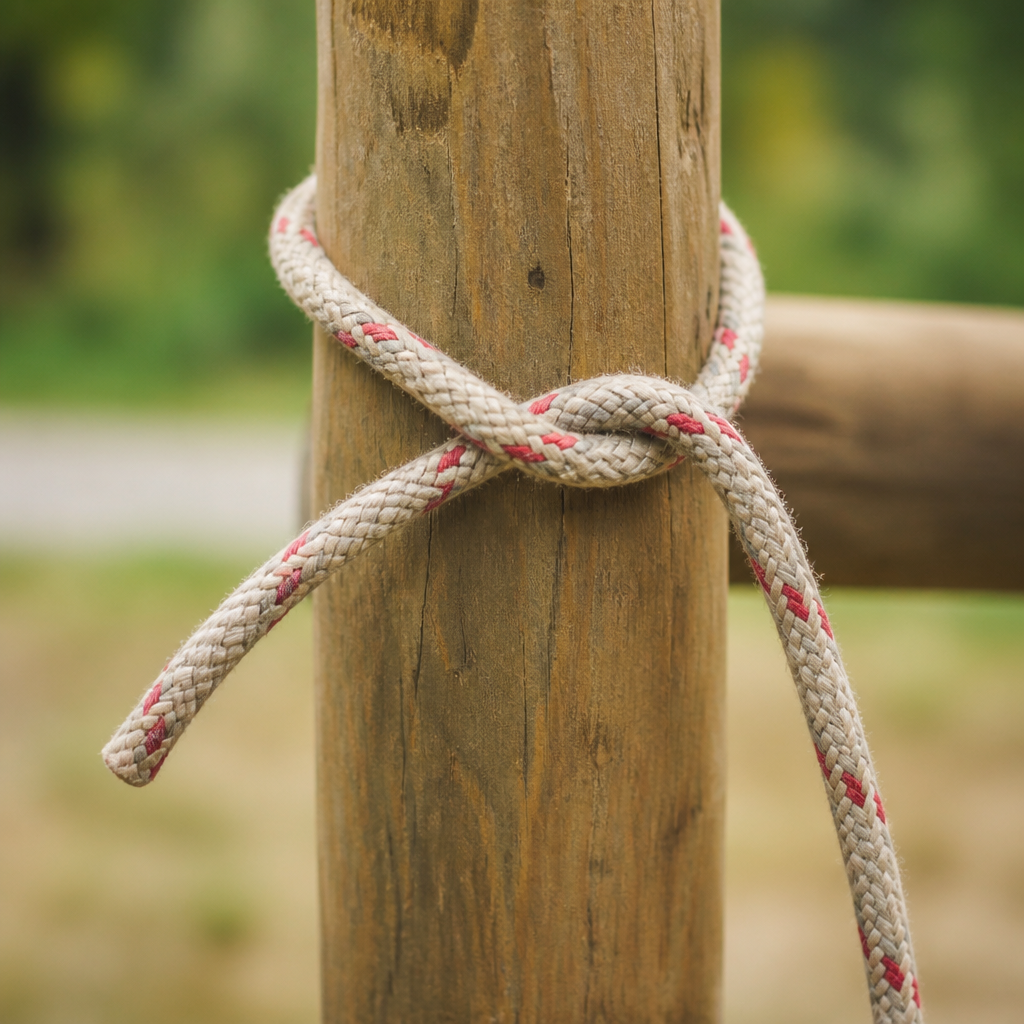
The clove hitch is formed by making two turns around an object, each one crossing over the rope and finishing with the working end tucked under its own last turn. Both turns are tied the same way, which is why the finished knot looks perfectly symmetrical once it is pulled snug against the post or rail it sits on.
It can be tied two ways: wrapped on with a free end, working turn by turn around a fixed post, or tied entirely "in the bight" and dropped over the top of a post or piling when both rope ends are already committed elsewhere, such as a mooring line already made fast at one end.
How to tie it
- Pass the rope around the post and cross it over itself to make the first turn.
- Bring the rope around a second time, in the same direction, laying the second turn next to the first.
- Tuck the working end under the second turn, between the rope and the post, and pull both ends to seat the hitch.
- Check that the two turns sit parallel and snug: a loose or crossed turn is where a clove hitch starts to slip.
Where it fails
A clove hitch holds well under a steady pull in one direction, but it is not a fully secure knot on its own. If the load repeatedly changes direction, such as a fender rubbing against a moving dock, or if the rope is stiff and springy, the turns can walk and the hitch gradually loosens rather than failing all at once. For anything where a slow, silent loosening would matter, sailors and riggers typically back it up with an extra half hitch or a light seizing around the working end.
Typical uses
Its speed and adjustability make it a natural choice for jobs that are temporary by nature: hanging a boat fender at a variable height, starting and finishing a diagonal lashing in camp or scout work, tying a tarp corner to a stake, or fastening a rope to a rail where it will be untied again within the hour. It is one of the oldest documented hitches in Western rope work, catalogued among the standard sailing knots long before it appeared in Clifford Ashley's 1944 reference "The Ashley Book of Knots."
Compared with the constrictor knot
The clove hitch and the constrictor knot are tied in a closely related way, which makes the difference between them a useful way to understand both. The table below sets them side by side on the points that decide which one to reach for.
| Knot | Ties around | Holds under a shifting load | Comes undone by hand |
|---|---|---|---|
| Clove Hitch | Post or rail | Loosely, may slip | Yes, always |
| Constrictor Knot | Bundle or rope end | Tightly, resists slip | Rarely once loaded |
Common questions
Is a clove hitch safe to climb on?
No. It is not rated or intended for life-safety loads of any kind. It belongs to temporary rigging and camp use, not to climbing or rescue systems, where a loop knot such as the figure-eight is used instead.
Why does it sometimes spin around the post?
A smooth, round post with little friction against the rope lets the whole hitch rotate under an off-axis pull. A rough surface, a squared post, or an added half hitch all reduce this tendency.