HT-05Hitches
Friction hitches compared: Prusik, Klemheist, Bachmann and autoblock
A friction hitch is a few wraps of thinner cord around a rope that grip when they are loaded and slide when the load comes off. The four in common use differ in the direction they hold, how easily they move and whether they can be let go under weight, and each one depends on a cord that is clearly thinner than the rope it grips.
Reviewed 20/10/2026, first documented 20/10/2026
The short answer: the Prusik grips in both directions and is the reference for climbing a rope; the Klemheist and the Bachmann slide upward more easily; the autoblock, or French prusik, releases while still loaded, which is why it backs up a rappel. Whichever you tie, the friction cord decides whether it works.
What is a friction hitch?
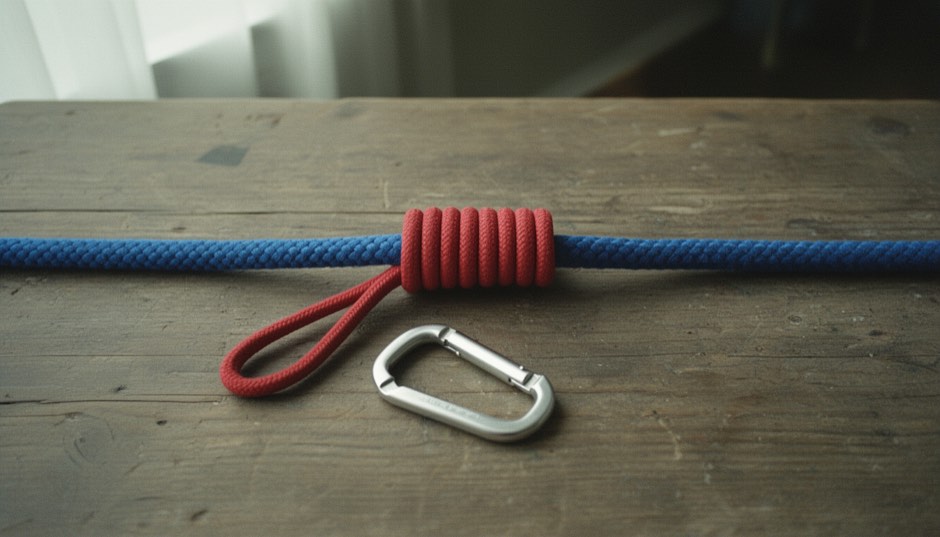
A friction hitch attaches one rope to another in a way that can be adjusted. Nothing in it is locked: a few wraps of cord squeeze the main rope, and the squeeze grows with the load. Push the wraps and the hitch slides; hang weight on the cord and it bites. That makes it a light, cheap stand-in for a mechanical ascender, and a ratchet in hauling systems where a loaded rope must not run back.
Choosing between friction hitches comes down to three questions: does it hold in one direction or both, how easily does it slide, and can it be released while weight is still on it?
How do the Prusik, Klemheist, Bachmann and autoblock differ?
Prusik
Described by the Austrian mountaineer Karl Prusik in 1931 and numbered 1763 in The Ashley Book of Knots, it passes the loop through itself, usually three times, into a symmetrical barrel that grabs whether the pull comes from above or below. The price of that symmetry: it is the stiffest of the four to slide, and the most likely to need working loose after a heavy load. The Prusik entry, with its tying steps and cord sizes, covers it in full.
Klemheist
Numbered 1762 in Ashley, the Klemheist spirals the loop around the rope and passes one end through the other, so it is loaded from a single hanging end and holds in that direction only. In return it slides up more easily than a Prusik, and it can be tied with a sewn sling of webbing. A reversed form, the Hedden hitch, was introduced by Chet Hedden in a 1960 issue of Summit magazine.
Bachmann
Named after the Austrian alpinist Franz Bachmann, it wraps the cord around the rope and the spine of a carabiner, which becomes a handle: holding it eases the friction so the hitch can be pushed along. That suits jobs where the hitch must be reset often, as in crevasse rescue and self-rescue. The carabiner should have a round cross-section, and a non-locking one is safer with its gate facing down, so an accidental unclip undoes one wrap rather than the whole hitch.
Autoblock, or French prusik
Also called the Machard, after the climber Serge Machard, the autoblock is wound around the rope and finished by clipping both ends of the loop into a carabiner. It holds in both directions, and a hand wrapped around the wraps and pulled down releases it even under load. That makes it a poor handhold for climbing and a good brake on the way down.
The four hitches side by side
| Hitch | Tied with | Loaded from | How you move it | Usual job |
|---|---|---|---|---|
| Prusik | Cord loop through itself | Either end | Push the barrel, unweighted | Ascending, rescue hauling |
| Klemheist | Cord loop or sewn sling | The hanging end only | Slide it up, unweighted | Ascending a fixed rope |
| Bachmann | Cord loop and a carabiner | The carabiner | Hold the carabiner | Crevasse and self-rescue |
| Autoblock | Cord loop, both ends clipped | Either direction | Pull the wraps down, even loaded | Rappel backup |
Which friction knot works best for climbing a rope?
Without mechanical ascenders, the classic set-up uses two hitches in tandem, one attached to the harness and one carrying a foot loop, moved up in turn so that one always holds. The Prusik is the reference because it holds from either side, the Klemheist slides upward with less fuss, and the Bachmann's carabiner gives the hand something to push. Leave the autoblock out: gripping it to pull yourself up is the very action that releases it.
Loop length matters too: a foot loop needs a metre of cord or more, an autoblock loop closer to 20 centimetres, and a long loop can always be shortened with a knot.
Which one backs up a rappel?
The autoblock. Tied with a short loop on the brake strand below the descender and clipped to a leg loop, it follows the brake hand down and locks if that hand lets go. It only has to match the pull of a brake hand, so four or five wraps of thin cord are enough. The loop must be short enough never to ride up into the descender, where it stops working, and a stalled descent restarts by pulling the hitch down by hand.
A hitch above the descender, usually a three-wrap Prusik or Klemheist clipped to the harness's main attachment point, works differently: it locks under load and has to be unweighted before the descent can go on.
Where do Blake's hitch, the Distel and the VT fit?
Tree climbers use the same principle. Blake's hitch is tied with the end of the climbing rope itself: in its common form, four turns around the standing line, the tail passed up through the lower two, then a stopper such as a single-strand figure-eight on the tail. Heinz Prohaska first presented it in an Austrian guides' periodical in 1981 and in the caving journal Nylon Highway in 1990; Jason Blake found it independently and described it to arborists in a 1994 letter to Arbor Age, and his name stuck.
The Distel hitch and the Valdotain tresse, or VT, are tied with a short separate cord on the climbing line and clipped to a carabiner. The Distel looks like a clove hitch with several extra descending wraps, which makes it easy to remember. The VT is the single-cord counterpart of the Machard tresse; tresse is French for braided and names a final crossing turn that adds hold and eases release.
What is friction cord, and how thick should it be?
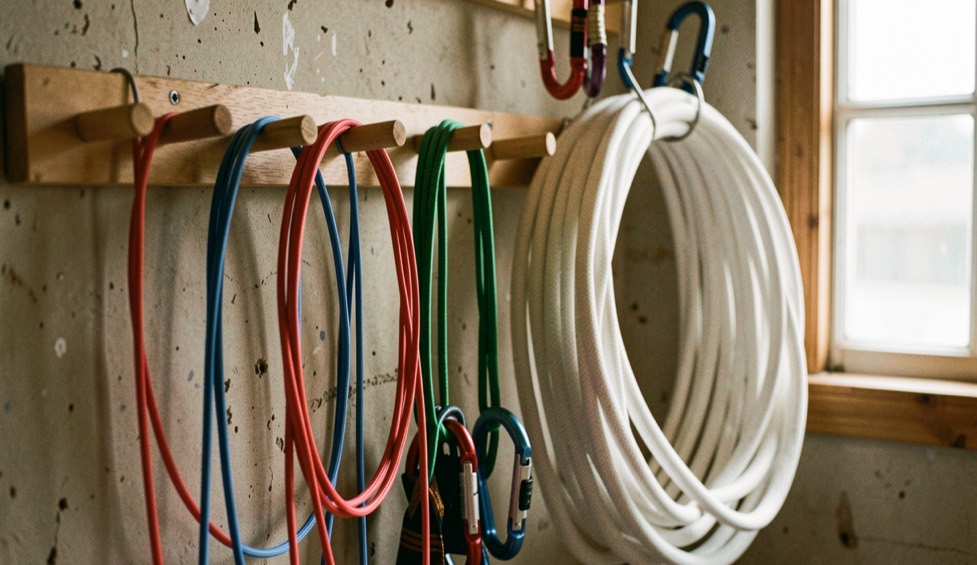
Friction cord is the cord a friction hitch is tied with. For climbing and rescue it is usually nylon accessory cord, sold in Europe to the EN 564 standard and closed into a loop with a double fisherman's knot. In tree work it is often bought as hitch cord with a sewn or spliced eye at each end, softer than general accessory cord and sometimes blended with heat-resistant fibres.
Diameter decides whether the hitch works at all. The usual starting range is 60 to 80 percent of the main rope's diameter, and some arborist testers put it instead as two or three millimetres below the climbing line. A cord as thick as the rope may slide like a slip knot and never lock. One that is too thin grips hard but jams after loading, has a lower safe working load and is awkward in gloves.
Material counts as much as size. Dyneema and Spectra melt at a low temperature, so they are avoided unless the cord is made for the job, because a hitch that slides under load heats up quickly.
Where do friction hitches let go?
In predictable ways. A friction hitch loses its grip on a frozen, wet rope. Sliding one while it is loaded heats both cord and rope. Too few wraps on a thin or slippery rope let it creep, and the fix is another wrap, tested by hand before weight goes on. On the other side of the ledger, an overloaded Prusik tends to slip rather than cut the rope's sheath, which is why it counts as gentler on a rope than a mechanical grab. The encyclopedic list of friction hitches names many more variants built on the same few ideas.
None of these knots should be learned from a page alone: anything that will hold a person belongs to hands-on practice with a qualified instructor and to the guidance that comes with the equipment.
Common questions
Is every friction hitch a Prusik?
No. Climbers often use the word for any hitch or device that grips a rope, but the Prusik is one specific knot that grips in both directions. The Klemheist, the Bachmann and the autoblock are relatives with different strengths.
Can a friction hitch be tied with webbing?
Some can. The Klemheist and the Bachmann are often tied with a sewn sling of flat webbing. A Prusik tied in webbing is not recommended for heavy loads or for holding a person, because it has been shown to slip.
How many wraps does a friction hitch need?
Usually two to four. Three is the common starting point for a Prusik or a Klemheist on a dry rope, four or five for a short autoblock below a descender, and one more whenever the rope is wet, icy, thin or slippery. The only reliable test is a firm pull by hand before the hitch takes weight.